
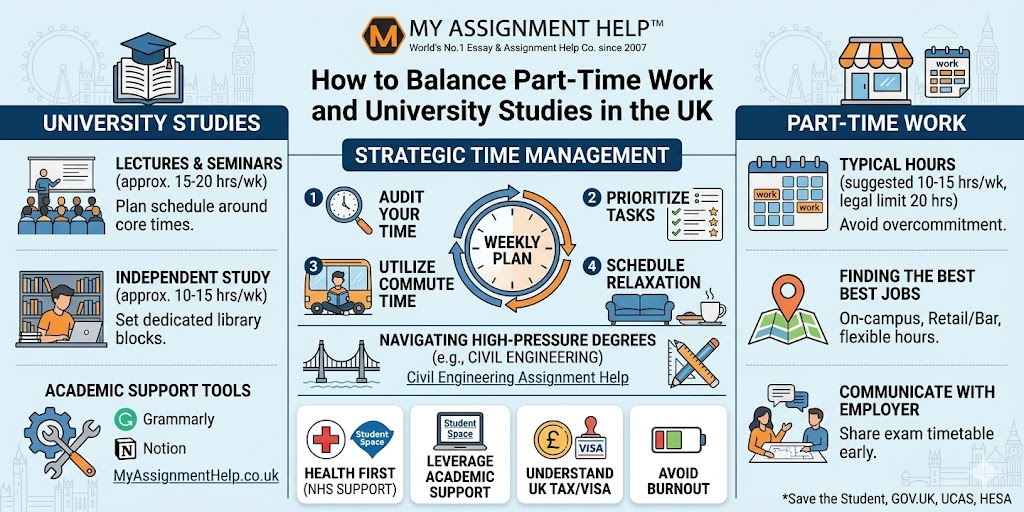
The British university experience is as much about academic rigor as it is about personal responsibility. In 2026, with the evolving economic landscape in the UK, a record number of students are entering the workforce while simultaneously pursuing higher education. According to recent student money surveys, nearly 74% of UK students now hold part-time jobs to cover rising maintenance costs and tuition fees.
While financial independence is rewarding, the “balancing act” is often the most significant challenge a student will face. Without a strategic approach, the pressure of deadlines can quickly lead to burnout.
The Reality of the “Working Student” in the UK
The primary hurdle isn’t just the physical hours; it’s the mental “context switching.” Moving from a high-pressure retail shift in the Manchester Arndale or a busy London café to a silent library desk requires immense cognitive discipline. When the academic workload peaks—typically during the mid-semester “deadline crunch”—even the most organized students can find their schedules fracturing.
To combat this, the modern UK student relies on a sophisticated “survival toolkit.” This often includes productivity apps like Notion for organization, Grammarly for refinement, and, increasingly, professional academic support. For those nights when the shift ends late and a 3,000-word essay is due at noon, many strategically choose to write my assignment for me through verified platforms. This isn’t just about outsourcing; it’s about tactical time management—using expert resources to maintain a high GPA while fulfilling the financial obligations that keep them in university.
Strategic Time Management: The UK Student Edition
To thrive, you must treat your time like a limited currency. Here is how to audit your week:
1. The 16-8-8 Rule
Divide your day into three segments: 8 hours for sleep, 8 hours for university/work, and 8 hours for everything else (commuting, eating, socializing). In the UK, most student visas (for international students) restrict work to 20 hours per week during term time. Adhering to this isn’t just a legal requirement; it’s a psychological safety net.
2. Utilize “Dead Time”
The UK has an extensive public transport network. Whether you are on a National Rail train to Birmingham or a bus in Leeds, use those 30-minute commutes for light reading or reviewing lecture notes.
3. Communicate with Employers
Most UK employers in student-heavy cities are accustomed to academic schedules. Provide your “exam timetable” at least four weeks in advance. Under the UK Employment Rights Act, while you don’t have a statutory right to time off for exams, most reputable employers value retention and will accommodate reasonable requests.
Navigating High-Pressure Degrees: A Technical Case Study
The difficulty of balancing work and study scales with the complexity of the subject. For instance, students enrolled in STEM subjects, particularly within the construction and infrastructure sectors, face a unique set of challenges.
A student pursuing a BEng or MEng in the UK must navigate rigorous laboratory hours alongside complex design projects. If you are struggling with the structural analysis of a new bridge design or fluid mechanics while working a weekend shift, you aren’t alone. Many students rely on specialized Civil Engineering Assignment Help to bridge the gap between practical site experience and the high-level theoretical calculations required by UK university boards. This targeted support ensures that your professional work doesn’t hinder your path to becoming a Chartered Engineer.
Financial Incentives and the UK Tax System
It is a common misconception that students don’t pay tax. In the UK, the Personal Allowance for the 2025/26 tax year is £12,570. If you earn above this, you will be subject to Income Tax.
- National Insurance (NI): You pay NI if you earn more than £242 per week.
- Tax Refunds: If you only work during summer holidays, you might be overtaxed initially. Ensure you keep your P45 and P60 documents to claim a refund via the HMRC portal.
Key Takeaways for Success
- Prioritize your Visa: If you are an international student, never exceed the 20-hour limit; it can jeopardize your stay in the UK.
- Batch your Tasks: Dedicate specific days solely to “deep work” (essays) and others to “light work” (reading/shifts).
- Health is Wealth: The NHS offers mental health support through “Student Space”—don’t hesitate to use it if the balance tips toward burnout.
- Leverage Expert Help: Use academic services strategically to manage peak periods, allowing you to focus on high-weightage modules.
Frequently Asked Questions (FAQ)
Q: How many hours should a student work per week in the UK?
Academic experts suggest 10 to 15 hours. International students on a Student Visa are legally capped at 20 hours during term time.
Q: Can I get fired for needing time off for exams?
In the UK, you should check your contract. While most have a “flexibility” clause, it is best to negotiate “leave of absence” during the exam season well in advance.
Q: Are there specific jobs that are better for UK students?
“Campus jobs” (Student Union bar, Library assistant, or Peer Mentoring) are ideal because they understand the academic calendar better than external commercial employers.
About the Author: Dr. Alistair Vance
Senior Content Strategist at MyAssignmentHelp Dr. Alistair Vance is an educational consultant with over 12 years of experience in the UK higher education sector. A former lecturer at a Russell Group university, Alistair specializes in student welfare and academic integrity. He now works with MyAssignmentHelp to develop resources that help students navigate the complexities of modern British degrees while maintaining a healthy work-life balance.
References & Data Sources:
- Save the Student: Student Money Survey 2025/26.
- UK Government (GOV.UK): Student visa work restrictions and Personal Allowance regulations.
- UCAS: Managing your money and time at University.
- Higher Education Statistics Agency (HESA): Student employment trends in the UK.
