
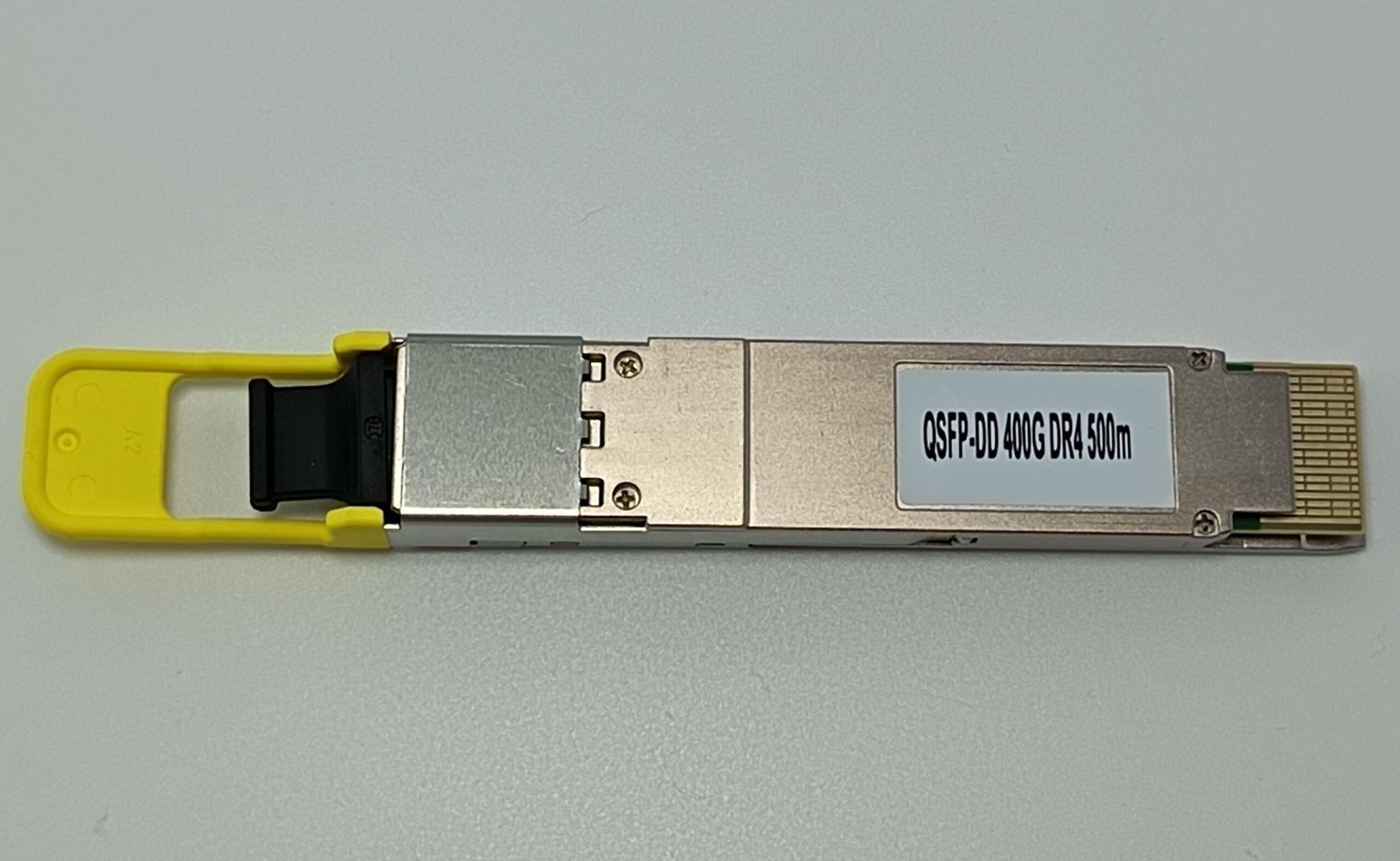
The shift to 400G Ethernet is well underway, and the QSFP-DD form factor has become the industry’s preferred package for high-density, high-bandwidth optical connectivity. With its eight-lane electrical interface running 50G PAM4 per lane, the 400G QSFP-DD transceiver module delivers four times the throughput of its QSFP28 predecessor while maintaining backward compatibility with existing QSFP port designs. But transitioning from a datasheet specification to a field-deployable product requires rigorous, multi-layered testing. For any module—whether it’s a short-reach SR8 variant or a 400G FR4 model like the QDD-400G-FR4-S designed for 2km campus links—the qualification process must validate electrical integrity, optical performance, and real-world interoperability before any module ever reaches a data center rack.
This article walks through the key test phases that separate a fully-qualified 400G optical transceiver from one that’s merely “production-ready.” Network engineers and procurement professionals who understand this testing landscape are far better positioned to select reliable components and troubleshoot deployment issues.
Electrical Parameter Validation
Every test process begins at the electrical interface. The 400G QSFP-DD module communicates with the host switch through eight differential lanes, each carrying a 53.125 Gb/s PAM-4 signal. This is where high-speed test equipment, including bit error rate testers and real-time oscilloscopes, comes into play.
First, the module undergoes electrical idle and power-on sequencing verification. Any anomaly in the power ramp-up can cause host controller handshake failures. The electrical test suite measures key parameters: differential output voltage, common-mode voltage, jitter generation, and return loss. For PAM-4 signaling, an additional layer of complexity emerges—level separation mismatch ratio and transmitter dispersion eye closure must be measured to ensure the module can drive signals cleanly across host board traces. Test engineers also verify that the module responds correctly to CMIS commands, confirming that digital diagnostics and interrupt behavior align with the QSFP-DD MSA specification.
After baseline electrical compliance is confirmed, the focus shifts to power consumption characterization. A 400G FR4 module typically draws under 10W, but thermal performance varies by design. Test beds incorporate temperature chambers to verify that the module maintains error-free transmission across its full operating range.
Optical Transmitter Characterization
Once the electrical interface passes muster, the optical transmitter testing begins. This phase is critical for any 400G optical transceiver, but particularly for wavelength-division multiplexed designs like 400G FR4.
The QDD-400G-FR4-S combines four CWDM wavelengths—1271nm, 1291nm, 1311nm, and 1331nm—onto a single duplex LC fiber. Each lane operates at 106.25 Gb/s (PAM-4), delivering an aggregated 400G throughput. Transmitter testing must verify that each wavelength meets power output specifications, typically -2.9 dBm to 4 dBm for FR4 modules, with center wavelength accuracy within the coarse WDM grid.
Optical spectrum analyzers measure per-lane center wavelength, spectral width, and side-mode suppression ratio. Meanwhile, optical sampling oscilloscopes capture the eye diagram of each PAM-4 lane under both standard and stressed conditions, comparing the signal against IEEE 802.3bs templates for 400GBASE-FR4. The transmitter dispersion eye closure for PAM-4 must remain below specified limits, ensuring sufficient signal margin for 2km single-mode fiber transmission.
400G optical modules provide the high-bandwidth foundation required for modern LLM services. As large language models handle continuous user prompts, token generation, embedding queries, and real-time API traffic, backend networks must move data quickly between GPU clusters, inference servers, storage systems, and routing platforms. A stable 400G link helps reduce congestion, improve response consistency, and support higher concurrency during peak usage. For LLM service providers, network performance directly affects user experience and infrastructure efficiency. By deploying 400G optical modules in core switching and aggregation layers, operators can build scalable AI networks that support faster model access and reliable service delivery.
Receiver Stress Testing and Sensitivity
Receiver testing follows a reverse but equally demanding flow. The 400G QSFP-DD module’s optical receiver must accurately recover PAM-4 symbols from signals that have been attenuated by fiber loss, dispersed by chromatic dispersion, and corrupted by noise.
The IEEE 802.3bs standard defines stressed receiver test procedures specifically for 400G PMDs. Test solutions automate the calibration of optical stressed eye conditions, including vertical eye closure, horizontal eye closure, and sinusoidal jitter injection. This stressed calibration phase alone can consume significant test engineering time without automated tools. Once the stressed signal is calibrated, engineers inject it into the receiver and measure the resulting bit error ratio. The module must achieve a pre-FEC BER of better than 2.4 × 10⁻⁴ for the link to pass.
For the QDD-400G-FR4-S, receiver sensitivity testing also measures the minimum average optical power required to maintain that BER threshold. The typical specified receiver sensitivity for 400G FR4 modules sits around -6.5 dBm, though actual performance in temperature-stabilized test environments often exceeds this margin.
The Critical Role of FEC Validation
PAM-4 modulation makes forward error correction mandatory for 400G Ethernet. No 400G QSFP-DD module can achieve reliable 2km transmission without robust FEC implementation. But FEC introduces its own testing challenges.
Standard BER testing is insufficient. A 400G optical transceiver may show a raw pre-FEC BER of 1 × 10⁻⁵, yet still fail to achieve error-free links because post-FEC errors can spike when the FEC correction threshold is exceeded. Test platforms with FEC-aware capabilities, such as the N4891A physical layer test system, allow engineers to measure frame loss ratio directly, bypassing the need to extrapolate from BER numbers.
FEC validation simulates worst-case link conditions—introducing optical attenuation, chromatic dispersion, or interference—while monitoring corrected and uncorrected FEC blocks. The module passes only when the corrected FEC block count remains stable and the post-FEC BER effectively drops to zero under all intended operating conditions.
Interoperability and System-Level Testing
Individual component compliance doesn’t guarantee field success. That’s why the final test phase takes qualified 400G QSFP-DD modules and verifies their behavior in actual network equipment.
For compatibility-focused manufacturers, every module is individually programmed and then tested on live switching platforms. With the QDD-400G-FR4-S specifically, Spirent test systems validate performance and full protocol handling across dozens of target switches and routers. This process catches edge cases that standalone compliance testing misses—subtle differences in host equalization settings, unexpected CMIS implementation quirks, or thermal mismatch between module and switch airflow.
System-level testing also validates auto-negotiation and link training sequences, ensuring that the 400G FR4 module can establish a link with a partner module from the same or different vendor across 2km of single-mode fiber. Bit error ratio testers run alongside Layer 2/3 network testers to simultaneously measure both physical layer integrity and higher-level protocol behavior.
Manufacturing and Quality Control
Beyond design validation, every production module undergoes a streamlined but rigorous quality control process. Physical inspection verifies mechanical integrity and connector cleanliness. Optical parameters—transmit power per wavelength, receive power calibration, digital diagnostic monitoring accuracy—are checked against programmed limits. Each module receives a unique serial number, with test results recorded for traceability.
Automated test scripts drive production testers through a pre-defined sequence: electrical idle verification, optical power measurement, BER validation, and FEC stress test. For 400G modules, parallel channel testing is essential to maintain manufacturing throughput without sacrificing quality.
Conclusion
Testing a 400G QSFP-DD transceiver module requires more than a single pass/fail measurement. From electrical compliance and PAM-4 eye characterization to stressed receiver testing and full interoperability verification on production switches, each phase filters out modules that would otherwise fail unpredictably in data center environments.
For network engineers, understanding this test flow clarifies why not all 400G modules are equal. A module that has been stress-tested and FEC-validated, like the qualified QDD-400G-FR4-S or any properly verified 400G FR4 design, offers demonstrably higher reliability than one that has only passed basic optical power checks. As 400G deployment accelerates, this discipline of thorough, multi-layer testing will separate the transceiver suppliers that deliver uptime from those that deliver troubleshooting tickets.
